
A Complete Guide to Strapping Solutions
Which Type of Strapping Is Right for Your Application? A Complete Guide
Choosing the right strapping material is one of the most important decisions in any packaging operation. Use the wrong type and you risk load failure, product damage, worker injuries, or unnecessary cost. Use the right type and you get a secure, efficient system that holds up through handling, transit, and storage.
Complete Packaging Products carries four main categories of strapping: steel strapping, plastic strapping (polypropylene and polyester), and cord strapping. Each has distinct properties that make it the right — or wrong — choice depending on your load, environment, and application method.
This guide explains how each type works, what it is best suited for, and how to decide which one is right for your operation.
Quick Comparison: Strapping Types at a Glance
| Strapping Type | Strength | Elongation | Corrosion Resistance | Best For |
|---|---|---|---|---|
| Steel Strapping | Highest | Minimal | Low (standard); High (zinc/stainless) | Heavy, rigid, sharp-edged loads |
| Polyester (PET) Strapping | High | Low to moderate | Naturally corrosion resistant | Heavy loads that shift or compress in transit |
| Polypropylene (PP) Strapping | Light to medium | High | Naturally corrosion resistant | Light to medium loads, general bundling |
| Cord Strapping (Woven/Composite) | Medium to high | High | Naturally corrosion resistant | Loads that shift, settle, or need surface protection |
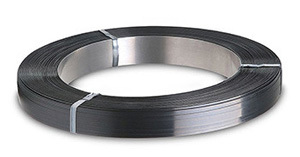
Steel Strapping
Steel strapping is the original industrial strapping material and still the strongest option available. It offers minimal elongation, which means it holds tension without giving under load — making it the right choice for rigid, heavy, or sharp-edged products that other strapping materials cannot safely contain.
Steel strapping is applied using a tensioning tool, then sealed with a metal seal or a sealless crimping tool. It is available in regular duty and high tensile grades, as well as zinc coated and stainless options for corrosive or outdoor environments.
Steel Strapping Is the Right Choice When:
- Your loads are very heavy — steel coils, pipe bundles, machinery, or large building materials
- Your product has sharp or rigid edges that could cut through plastic strapping
- Your loads are shipped by rail, flatbed, or open-top trailer and must meet ASTM or AAR specifications
- You need maximum break strength in the narrowest possible strap width
- Your loads do not compress or settle during transit
Steel Strapping Is Not the Right Choice When:
- Your loads compress or settle — steel cannot recover tension once slack develops
- Worker safety is a priority — cut steel strap edges are sharp and can cause injuries
- You need corrosion resistance without a zinc or stainless upgrade
- Your loads have finished surfaces that could be scratched or damaged
Steel Strapping Options at Complete Packaging Products
- Regular Duty Steel Strapping — General warehouse and distribution applications
- High Tensile Steel Strapping — Heavy freight, rail cars, steel coils, pipe bundles
- Zinc Coated Steel Strapping — Outdoor storage, moisture-prone environments, lumber and building materials
- Stainless Steel Banding — Marine, chemical, food processing, and long-term outdoor applications
- Portable Steel Strapping — Field use, job sites, and lower-volume applications
Steel strapping requires compatible steel strapping tools, steel strapping seals, and dispensers to complete the system.
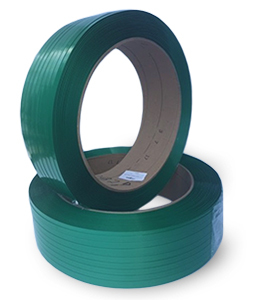
Polyester (PET) Strapping
Polyester strapping, also called PET strapping, is the strongest plastic strapping option and the most common alternative to steel strapping in medium to heavy-duty applications. It provides high break strength with the ability to recover tension when loads compress or settle during transit — something steel strapping cannot do.
Polyester strapping is naturally corrosion resistant, does not leave sharp edges when cut, and is significantly lighter than steel. It is applied using manual, pneumatic, or battery-operated plastic strapping tools and secured with seals or friction welds.
Polyester Strapping Is the Right Choice When:
- Your loads are heavy but may compress, settle, or shift during transit
- You want the strength of steel strapping with improved worker safety and ease of handling
- Your loads have finished or sensitive surfaces that could be damaged by steel
- You need corrosion resistance without a special coating
- Your operation processes high volumes and would benefit from pneumatic or battery-powered tools
- You are shipping loads that require maintained tension over longer transit times
Polyester Strapping Is Not the Right Choice When:
- Your loads are extremely heavy or rigid and require the absolute highest break strength — steel is stronger
- Your products have sharp edges that could cut through the strap
- Cost is the primary driver and your loads are light — polypropylene is more economical for lighter applications
Polyester Strapping Options at Complete Packaging Products
- CPP and Fromm Polyester Strapping — ASTM-certified PET strapping in multiple widths and break strengths
- Signode Polyester Strapping — Premium PET strapping from a trusted industrial packaging brand
- Polyester Strapping Mini Coils — Shorter coils for portable or lower-volume use
Complete the system with plastic strapping tools and plastic strapping seals and buckles.
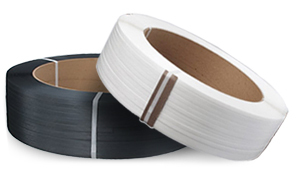
Polypropylene (PP) Strapping
Polypropylene strapping is the most widely used plastic strapping for light to medium-duty applications. It is the most cost-effective strapping option available, making it the standard choice for general warehouse palletizing, carton bundling, and distribution center operations where loads are not exceptionally heavy.
Polypropylene strapping has higher elongation than polyester, which allows it to absorb shock during handling. However, because it does not retain tension as well as polyester, it is not the best choice for loads that must stay tightly secured over long transit distances or for applications where load compression is a factor.
Polypropylene Strapping Is the Right Choice When:
- Your loads are light to medium weight and stable
- Cost efficiency is important and high tensile strength is not required
- You are palletizing, unitizing, or bundling products for distribution
- Your loads are handled carefully and shipped over shorter distances
- You need a high-volume, economical strapping solution for everyday warehouse operations
Polypropylene Strapping Is Not the Right Choice When:
- Your loads are heavy — PP does not provide the break strength or tension retention of PET or steel
- Your loads must stay tightly secured over long transit distances or extended storage
- Your load may settle or compress — PP loses tension more quickly than polyester
- Outdoor exposure or UV degradation is a concern over long periods
Polypropylene Strapping Options at Complete Packaging Products
- Polypropylene Strapping — Available in multiple widths, thicknesses, and coil lengths for standard warehouse use
Compatible with plastic strapping tools and plastic strapping seals and buckles. For higher-volume operations, tabletop semi-automatic strapping machines can significantly increase throughput.
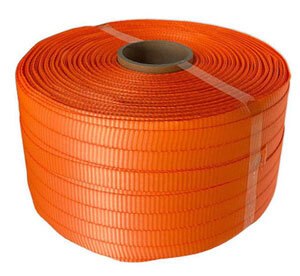
Cord Strapping
Cord strapping is a woven or bonded polyester strapping material that provides excellent flexibility, shock absorption, and load protection — particularly in applications where loads may shift, settle, or have uneven surfaces. It serves as a practical alternative to both steel strapping and rigid plastic banding, with the added benefit of being safer to handle and gentler on load surfaces.
Cord strapping is secured using wire buckles rather than metal seals, which simplifies the sealing process and eliminates the need for a separate sealing tool in many applications.
Cord Strapping Is the Right Choice When:
- Your loads have irregular or uneven surfaces that benefit from a flexible, conforming strap
- Your loads may shift or compress during transit and need a strap that absorbs shock without breaking
- You want an alternative to steel strapping that is safer to handle and does not rust
- Your loads have finished surfaces that could be damaged by steel edges
- You are securing loads for flatbed, export, or heavy industrial transport
- Your operation involves outdoor storage or moisture exposure
Cord Strapping Is Not the Right Choice When:
- Your loads are extremely heavy or rigid and require the maximum break strength of steel or high tensile PET
- Your loads have very sharp edges that could cut through woven fibers
- Cost is the primary driver and your application is light-duty — polypropylene is more economical
Cord Strapping Options at Complete Packaging Products
- Bonded Polyester Cord Strapping — Polyester filaments bonded into a flat strap; ideal for general bundling, palletizing, and unitizing where high break strength is not the primary requirement
- Composite Polyester Strapping — High-strength polyester fibers in a polypropylene coating; stiffer, easier to thread under pallets, frequently used as an alternative to steel strapping for heavy pallet loads, lumber, pipe, and construction materials
- Woven Polyester Cord Strapping — Woven construction for superior flexibility and shock absorption; well suited for export crating, machinery, heavy equipment, flatbed transport, and irregular loads
- Woven Polyester Cord Strapping Kits — Complete starter kits with strapping, buckles, tensioner, and cutter
- GatorLASH Heavy Load Containment System — Heavy-duty woven polyester lashing engineered for large, high-value, or oversized cargo in trucks, railcars, shipping containers, and flatbed trailers
Cord strapping requires cord strapping tools, wire strapping buckles, and cord strapping dispensers.
How to Choose the Right Strapping: Step-by-Step
Step 1: How Heavy Is Your Load?
- Very heavy (steel coils, machinery, heavy freight) → Steel Strapping or Composite Cord Strapping
- Heavy (pallets, lumber, building materials) → Polyester Strapping or Composite Cord Strapping
- Medium (standard pallet loads, bundled products) → Polyester Strapping or Woven Cord Strapping
- Light (cartons, bundling, general distribution) → Polypropylene Strapping or Bonded Cord Strapping
Step 2: Will the Load Compress, Shift, or Settle in Transit?
- Yes — the load may compress or shift → Polyester Strapping or Cord Strapping (both recover tension as the load moves)
- No — the load is rigid and stable → Steel Strapping or Polyester Strapping
Step 3: Does Your Load Have Sharp or Rigid Edges?
- Yes — sharp or rigid edges → Steel Strapping (best cut resistance) or Composite Cord Strapping
- No — smooth or finished surfaces → Polyester, Polypropylene, or Woven Cord Strapping
Step 4: What Is the Environment?
- Indoor, controlled environment → Any strapping type based on load requirements
- Outdoor or moisture exposure → Zinc Coated Steel, Polyester, or Cord Strapping
- Marine, chemical, or corrosive environments → Stainless Steel Banding or Woven Cord Strapping
Step 5: How Important Is Worker Safety and Ease of Handling?
- Safety is a priority → Polyester, Polypropylene, or Cord Strapping — none produce sharp edges when cut
- Maximum strength is the priority and safety protocols are in place → Steel Strapping
Step 6: What Is Your Application Volume?
- Low volume or field/job site use → Manual tools; consider Portable Steel Strapping or Cord Strapping Kits
- Medium volume → Manual or battery-operated tools with standard coil strapping
- High volume → Battery-operated or pneumatic tools, or a semi-automatic strapping machine
Strapping Material Comparison by Industry
| Industry / Application | Recommended Strapping |
|---|---|
| Steel coils, pipe, and metal products | High Tensile Steel Strapping |
| Lumber and building materials | Composite Cord Strapping or Zinc Coated Steel Strapping |
| General warehouse and distribution palletizing | Polypropylene Strapping or Polyester Strapping |
| Heavy pallet loads and industrial shipping | Polyester (PET) Strapping or Composite Cord Strapping |
| Export crating and flatbed transport | Woven Cord Strapping or GatorLASH Lashing |
| Machinery and heavy industrial equipment | Woven Cord Strapping or High Tensile Steel Strapping |
| Recycling and baling operations | Bale Ties or Black Annealed Box Wire |
| Marine, coastal, and chemical environments | Stainless Steel Banding or Woven Cord Strapping |
| Agriculture (hay, straw, cotton baling) | Stump/Stem Wire for Balers |
| Rail freight and open-top car shipments | High Tensile Steel Strapping (ASTM/AAR compliant) |
| Job site and field use | Portable Steel Strapping or Cord Strapping Kits |
Frequently Asked Questions
What is the strongest strapping available?
Steel strapping — specifically high tensile steel strapping — provides the highest break strength of any strapping material. For applications where steel is not practical, composite cord strapping and polyester strapping are the strongest alternatives.
Can polyester strapping replace steel strapping?
In many applications, yes. Polyester strapping and composite cord strapping are frequently used as alternatives to steel strapping, particularly where loads do not have extremely sharp edges and where worker safety, corrosion resistance, and tension recovery are important factors. However, for very heavy loads or rail applications with ASTM/AAR requirements, steel strapping remains the standard.
What is the difference between polypropylene and polyester strapping?
Polypropylene (PP) strapping is more economical and best suited for light to medium-duty applications. Polyester (PET) strapping provides higher break strength and better tension retention, making it the right choice for heavier loads or longer transit distances. See our plastic banding category for a full comparison.
What is cord strapping and how is it different from plastic strapping?
Cord strapping is made from woven or bonded polyester fibers rather than extruded plastic. This construction gives it greater flexibility and shock absorption compared to rigid plastic strapping, making it well suited for irregular loads, machinery, and flatbed transport. It is secured with wire buckles rather than crimp seals. See our full cord strapping category for options.
What strapping tools do I need?
Tool requirements depend on the strapping material you select. Steel strapping requires steel strapping tools. Polyester and polypropylene require plastic strapping tools. Cord strapping requires cord strapping tools. Our packaging specialists can help you select the right tool for your strap width, application volume, and sealing method.
Not Sure Which Strapping Is Right for You?
Complete Packaging Products stocks professional-grade steel, plastic, and cord strapping from trusted manufacturers including Signode, Fromm, Encore Packaging, DuBose, Burlan, and Leicatex. Our products are sourced from North American manufacturers and built to perform in real industrial packaging environments.
If you are not sure which strapping material, width, or tool is right for your application, call our packaging specialists at 866-787-2790, Monday through Friday, 8:00 AM to 4:00 PM EST. We will help you match the right strapping system to your load, environment, and operation.
Shop Steel Strapping | Shop Plastic Strapping | Shop Cord Strapping
Recent Posts
-
Bulk Boat Shrink Wrap: A Guide for Marinas & Installers
Buying Boat Shrink Wrap in Bulk: A Guide for Marinas and Professional Installers When boat shrink wr …Oct 19th 2026 -
Why Packaging Quality Matters: Choosing a Supplier You Can Trust
Why Quality Control Is Key for Packaging Suppliers When businesses order packaging materials, they e …Sep 1st 2026 -

How to Shrink Wrap Your Boat for Winter Storage
How to Shrink Wrap Your Boat for Winter Storage Shrink wrapping your boat is one of the best ways to …Sep 1st 2026